Risk Score
Understanding multi-dimensional risk assessment for UK companies. Our risk score predicts company failure probability using machine learning, giving you a clear picture of financial health, compliance, governance, and operational resilience.
Overview
The uvagatron.com Risk Score is a 0–100 composite score that predicts the probability of a UK company failing. Unlike simple heuristic scores, our model is trained on historical company failures and validated against real insolvency data — covering dissolutions, liquidations, and administrations.
The score draws on 48 independent data sources, including Companies House filings, FCA registers, sanctions lists, The Gazette, land registry records, payment practices, and more. Each company is evaluated across five risk dimensions, weighted by their predictive importance, to produce a single composite score.
A higher score means lower risk. A company scoring 85 has strong fundamentals and minimal warning signals, while a company scoring 15 has multiple risk factors that historically correlate with business failure.
Score Classifications
Every company is assigned one of five risk classifications based on its composite score. These classifications provide a quick summary of overall risk posture.
| Classification | Score Range | Interpretation |
|---|---|---|
| Robust | 75 – 100 | Low risk. Strong fundamentals across all dimensions with no significant warning signals. |
| Stable | 55 – 74 | Generally healthy. The company operates normally with only minor concerns in isolated areas. |
| Watch | 40 – 54 | Moderate risk. One or more dimensions show concerning patterns that require attention. |
| Elevated | 25 – 39 | Significant risk factors present. Multiple warning signals suggest deteriorating conditions. |
| Critical | 0 – 24 | High failure probability. Immediate concerns such as active sanctions, liquidation, or severe regulatory action. |
Five Risk Dimensions
The composite score is built from five independent dimensions, each measuring a different aspect of company health. The weight reflects how strongly each dimension predicts failure.
Overdue accounts, outstanding mortgages, payment practices to suppliers, XBRL financial filings, and government grants. Captures both current financial position and payment behaviour.
FCA regulatory status, sanctions listings, Gazette notices, AML indicators, ICO data protection registrations, and disqualified director associations. Measures regulatory standing.
PSC (Persons with Significant Control) structure, director tenure and turnover, filing history completeness, and company age. Evaluates management stability and transparency.
Director contagion analysis across 24.5 million appointment links, PSC ownership chains, and corporate group structures. Identifies risk spreading through shared directors and owners.
CQC inspection ratings, food hygiene scores, ESG indicators, website verification status, and trade activity signals. Reflects day-to-day operational quality where data is available.
Critical Overrides
| Signal | Maximum Score | Reason |
|---|---|---|
| Active sanctions | 5 | Company or associated person appears on UK/international sanctions lists |
| Winding-up petition | 8 – 10 | Court petition to dissolve the company has been filed |
| Liquidation | 8 – 10 | Company is in active liquidation proceedings |
| Disqualified director | 15 | One or more directors are disqualified by the Insolvency Service |
| Strike-off action | 28 – 42 | Company is being struck off the register (range depends on company age) |
How to Read the Score
On every company profile page, the risk score is displayed as a gauge with a colour-coded classification. Below the gauge, a radar chart shows how the company performs across all five dimensions at a glance.
- Click any dimension on the radar chart to expand it and see the individual sub-score components that contribute to that dimension.
- Higher score = lower risk. The scale runs from 0 (maximum risk) to 100 (minimum risk).
- Scores are relative. Each company is evaluated against the broader population of UK companies, so the score reflects how a company compares to its peers.
- Scores update daily as new data arrives from Companies House, regulatory bodies, and other sources. Changes of 10 or more points trigger an alert if you have monitoring enabled.
Methodology
The risk score is produced by a machine learning model trained on historical UK company failures — including dissolutions, compulsory liquidations, and voluntary administrations. The model uses over one hundred features per company, drawn from financial filings, regulatory records, corporate network analysis, and operational data.
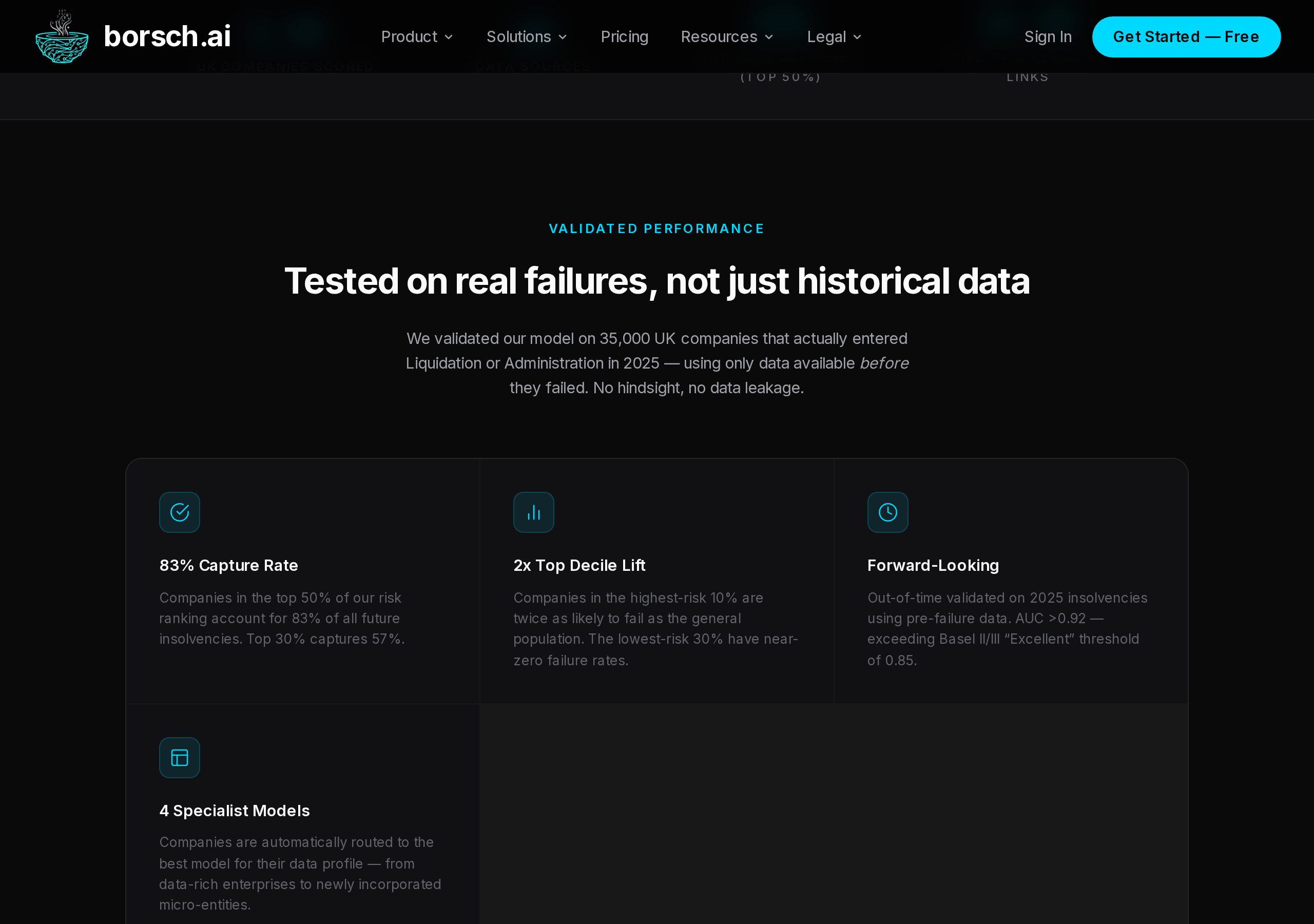
Model performance is validated on out-of-time insolvency data: companies that failed after the training period, ensuring the model generalises to future events rather than overfitting to historical patterns.
For full technical details on the model architecture, feature engineering, and validation methodology, see the Risk Score white paper.